

Walton County boasts 26 miles of shoreline and is home to the tony beach towns of Seaside, WaterColor and Alys Beach, along state Scenic Highway 30A. It's known for emerald clear waters and white sand so soft and fine it squeaks underfoot.
It has also become ground zero in a protracted battle over where personal property lines end and the public's right to set up a chair and umbrella begin.
The decade-long fight — including the defeat of county efforts to keep the sand open to all, flip-flopping state laws and landowner lawsuits — has left beachgoers to navigate a confusing patchwork of beach access.
As the conflict spreads to other coastal communities, residents in the Sunshine State are eyeing a Florida constitutional amendment to settle the issue once and for all — and to warn beach lovers elsewhere that they may be next.
"Our beaches should be public," says Dave Rauschkolb, a founder of the nonprofit group Florida Beaches for All. "They should be shared as they have for eons."
Rauschkolb walks down a boardwalk at a neighborhood access point that leads to a pocket of public beach sandwiched between multimillion-dollar Gulf front homes.
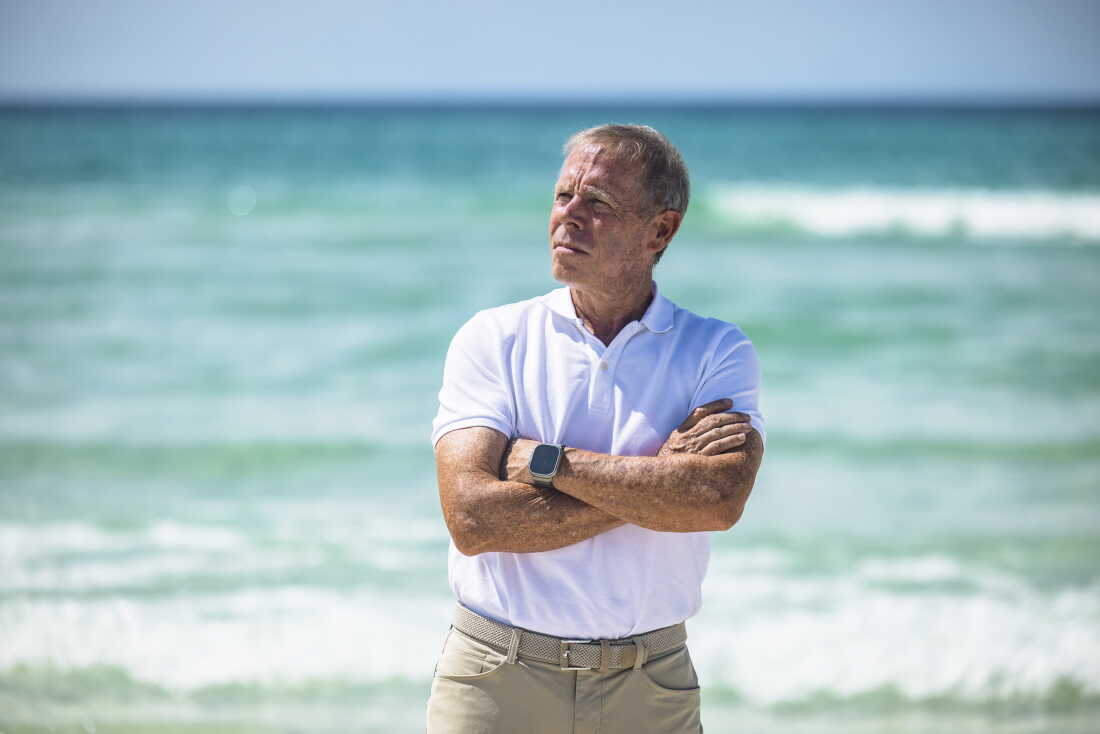
Dave Rauschkolb, the owner of Bud & Alley's restaurant in Seaside, Fla., helped found the non-profit Florida Beaches for All to advocate for open beaches.
"On a busy day, this will just be packed between the signs," he says, pointing out no-trespassing and private-beach signs that border the public beach.
Security guards posted under red umbrellas greet beachgoers as they descend the boardwalk. Surrounding landowners have hired them to keep people from spilling over onto their beaches.
Rauschkolb, a restaurateur who grew up surfing nearby, says that's just wrong.
"What we're fighting for is the right for people to go to a public access and walk as far as they want with their beach chairs and set up on any beach," he says.
But homeowners, like Eric Wilhelm, an entrepreneur from Marietta, Ga., who spends about half his time at his beach house here, say that this encroaches on their constitutionally protected property rights.
"It's the foundational rule of the way that we live in this freedom-loving country of ours," he says. "Once that breaks down, then we have anarchy and chaos."
Enjoying a cigar from the deck of his home on stilts, Wilhelm looks out over the sugar white sand and glistening Gulf, recalling how his family was drawn here in the 1990s for the seclusion and low-density development. But now, he says, it has become something quite different.
"You're sitting at ground zero of the beach wars."
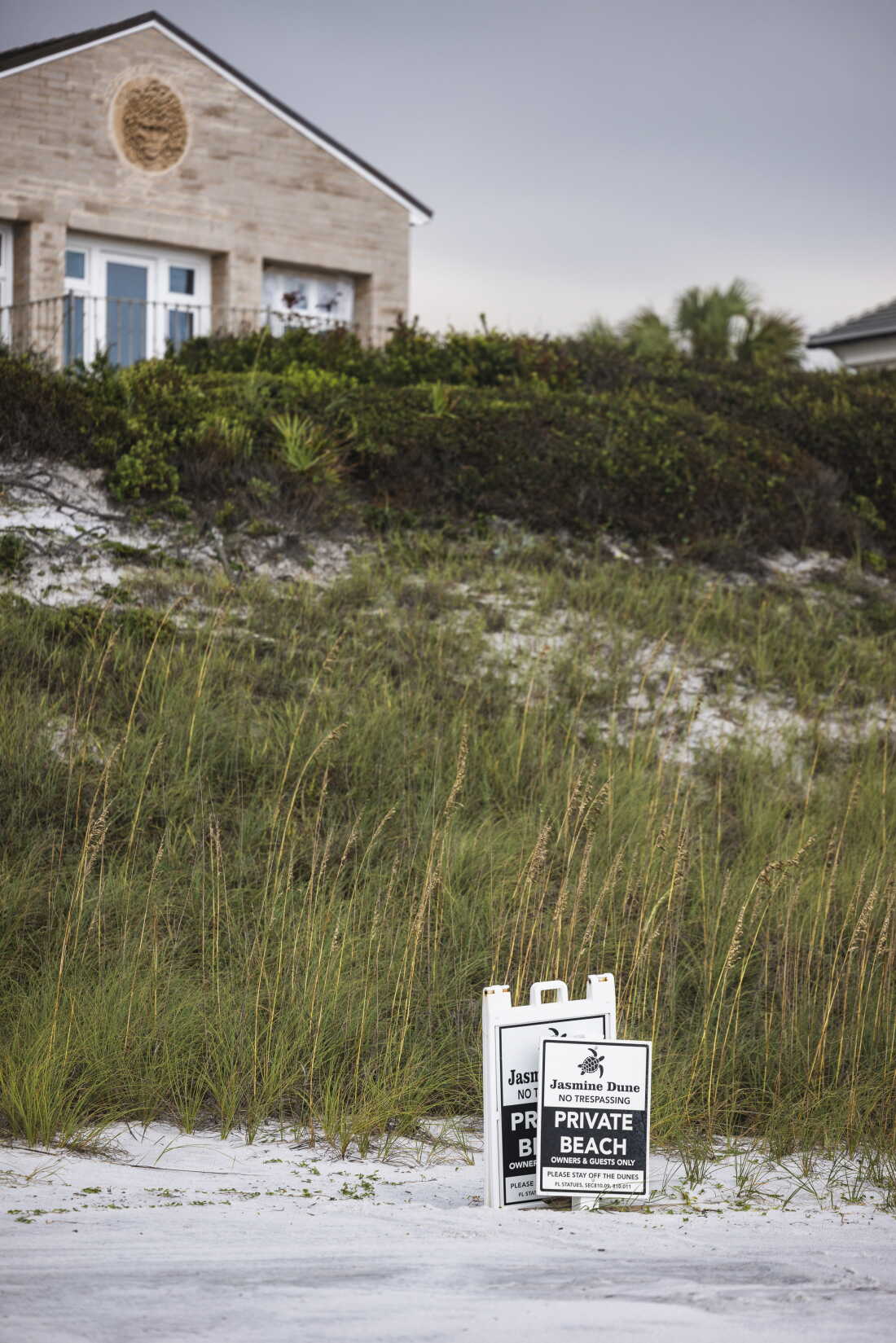
"No trespassing" signs and private security guards are prevalent along the 26-mile shoreline in south Walton County as disputes have escalated between beachgoers and property owners.
The area has experienced explosive growth. There's not enough public beach space for all the new residents and tourists, Wilhelm says, so they end up on his property and, sometimes, not just to sit in the sand.
He has surveillance cameras set up and says he has called the sheriff about people trespassing.
"There will be people downstairs with cars parked in our driveway. They put a table underneath our house," he says. "They'll just set up a little afternoon cocktail party just because there's nobody in the house."
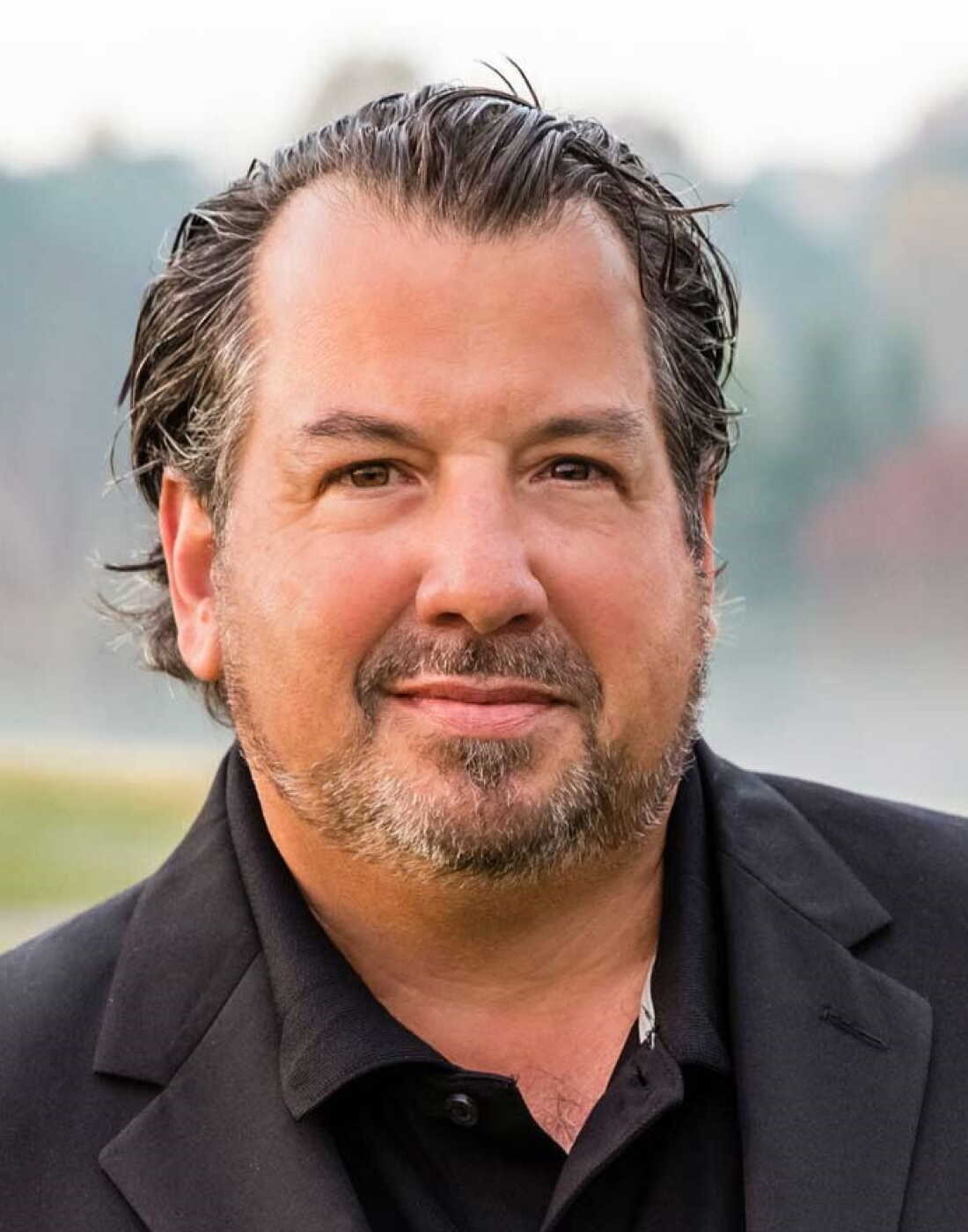
Eric Wilhelm, an entrepreneur from Marietta, Ga., spends about half his time at his beach house in Florida and has called the sheriff about beachgoers trespassing on his property. He says claiming private land for public use amounts to communism.
Eric Wilhelm
Wilhelm is among the property owners who prevailed in a protracted legal battle with Walton County over beach access. The conflict has been escalating for a decade, dating to when the county commission passed a customary-use ordinance, declaring the public right to all beaches that had traditionally been used for recreation.
That's when some politically connected homeowners, including former Arkansas Gov. Mike Huckabee, complained. And the Florida Legislature passed a 2018 law that required the county to sue landowners to prove customary use.
Tallahassee attorney Kent Safriet represented some 80 landowners, including Wilhelm. Safriet says customary use is a concept derived from English law that does not square with the U.S. Constitution.
"The Fifth Amendment [says] no private property can be used for public purposes without just compensation," Safriet says. "So, it's in our view that the English doctrine of customary use would be unconstitutional in America."
He says the whole fight boils down to control.
"The county wants to control the beach, and I understand why," says Safriet. "But the county has not recognized thus far that the beach is private and these private property owners have property rights on the beach, no different than the county commissioners have in their front yard."
Last year, the Florida Legislature repealed its 2018 law under public pressure to protect beach access, but Walton County had already settled with landowners over the customary-use issue. At the same time, some landowners have gone to court to claim quiet title to the sand behind their homes.
What's left is ambiguity, says Walton County Sheriff Michael Adkinson Jr., and his deputies are caught in the middle.
"To someone who is in favor of the beaches being open to everybody, they say the sheriff's office are jackbooted thugs," Adkinson says. "People that own the private property say we're godless, liberal communists who allow everybody to go on their beach."
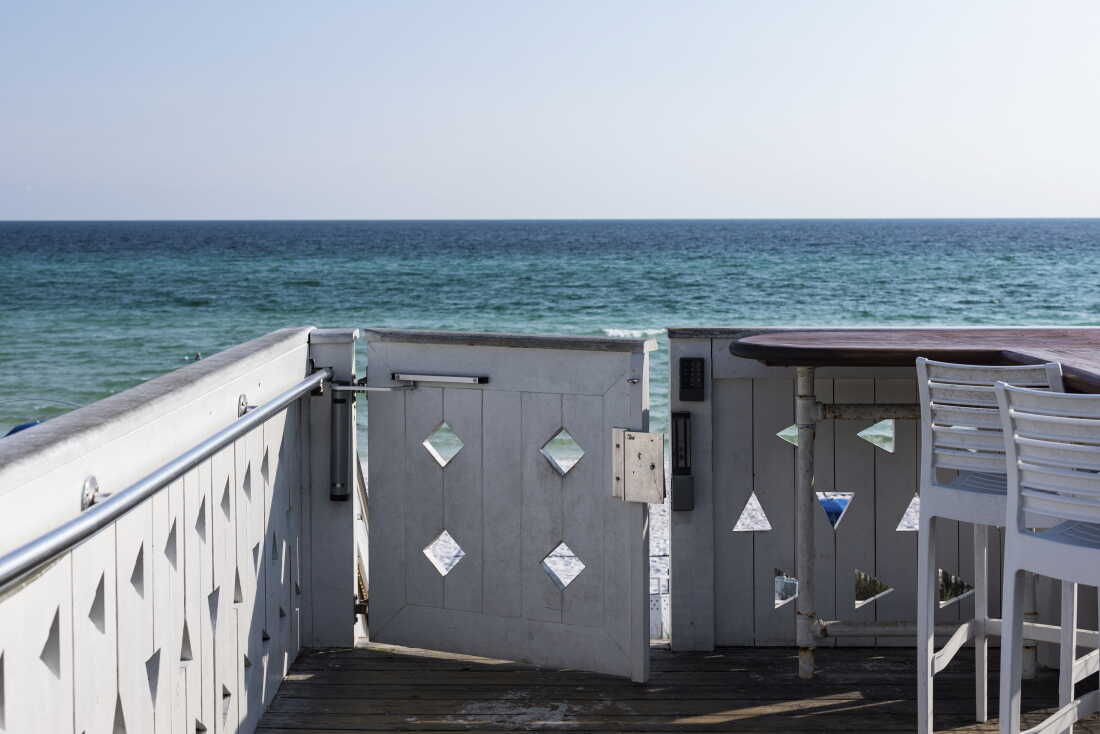
A gate grants keypad access to the beach near the Coleman Pavilion obelisk in Seaside.
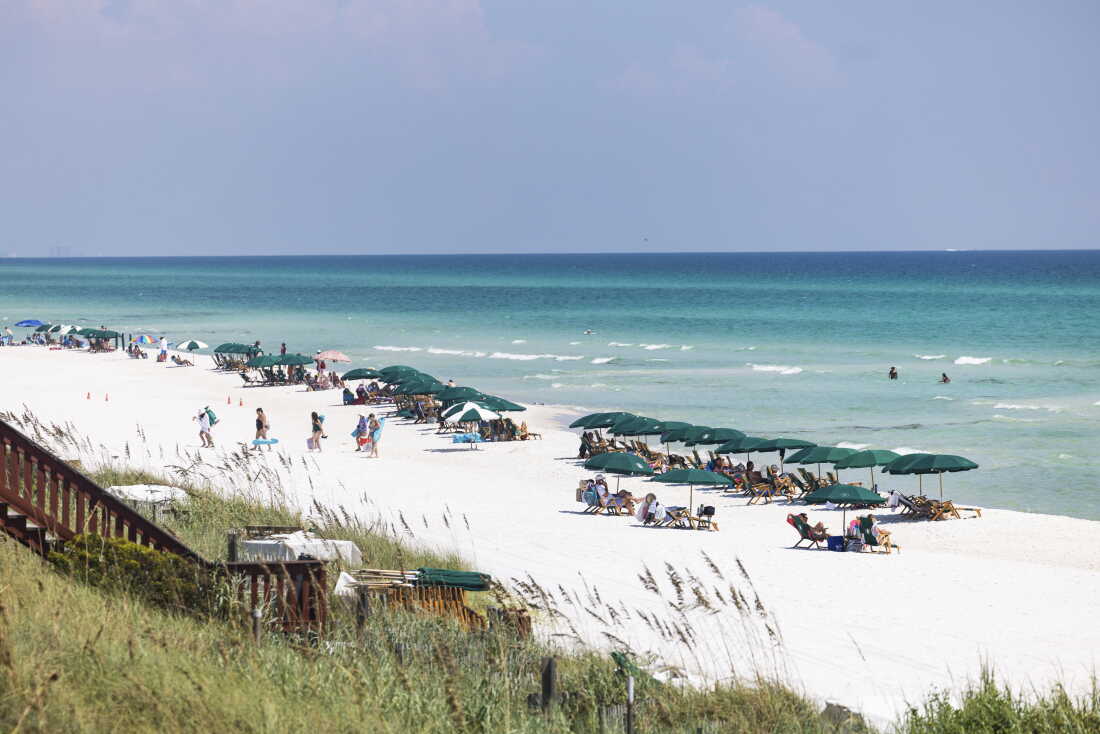
Beachgoers in Rosemary Beach, one of several communities that have experienced explosive growth in the last decade.
Adkinson, who has been sheriff since 2009, says he's getting more calls than ever over beach disputes. But deputies, he says, aren't in a position to legally judge property boundaries.
"First of all, we don't know whether the property is private. We don't know whether you actually have legal guardianship of it. We don't know what the legal boundaries of the property are," Adkinson says. "There's a lot to ascertain."
So they mostly just try to lower the temperature when there's a standoff.
"In a decade, I don't think we've made an arrest for trespassing on the beach, because we've been able to resolve these."
The sheriff is being sued for not enforcing the law by Brian Littrell, a member of the band the Backstreet Boys. Littrell's beachfront property has become a flash point in the beach battles.
Littrell's attorney, Peter Ticktin, likens the situation to people setting up a barbecue in your backyard and you calling the sheriff to report trespassing.
"And if the sheriffs came and talked to the people but didn't even tell them that they have to leave, they are basically part of the problem," says Ticktin.
Littrell has also filed a civil lawsuit for a second time against a 68-year-old woman for trespassing. Her supporters say she was within her rights, sitting in a chair seaward of the mean high-tide line considered public land — roughly where the surf laps the shore.
On a recent afternoon at high tide, beach activist Sara Day points out where the dividing line is.
"The tide is coming up right now," she says. "So you can see you don't have a lot of space, but you can see all that wet sand over there. You can be there."
Day has created an app called Shoreline Defender that helps people find the mean high-tide line on Florida beaches.
"It is not telling you to trespass," she says. "It is giving you a bandwidth of how much sand you might have at any given time."
She was motivated to develop the free app after a private security guard tried to kick her family off a beach. She says the problem is exacerbated by local concessionaires whom the county allows to set up beach chair rentals along the water line in prime areas.
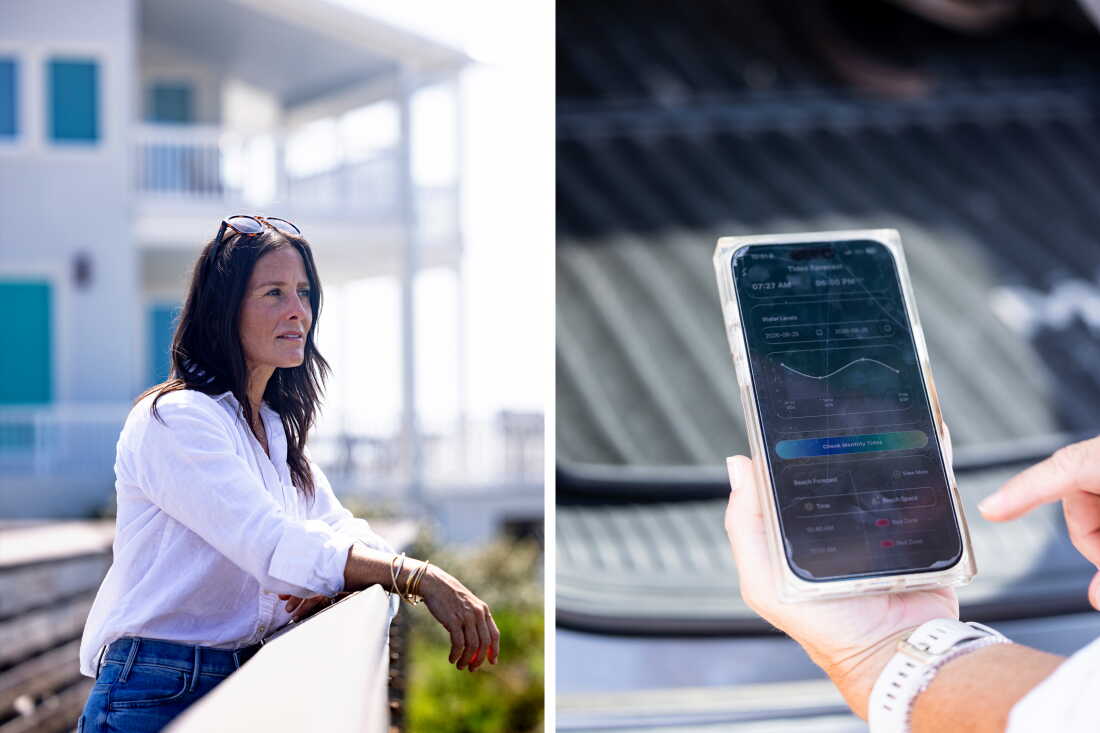
Beach activist Sara Day created an app called Shoreline Defender to help people figure out where you can set up a beach chair and umbrella along Florida beaches.
Day says a beach should bring solace, not conflict. But she's only seeing the situation escalate.
"It's very important to make the distinction that if you live in a coastal community anywhere in the United States, you need to be watching this, because we never thought it would happen here. But here we are," she says. "You need to be on high alert."
Indeed, similar conflicts are brewing elsewhere in Florida, and that has led to a grassroots campaign for a state constitutional amendment allowing public beach access from the dune line to the water.
Real estate agent Linda Miller says Walton County should have been preserving more public beach space long ago. The county's population has more than doubled since 2000, and its beaches drew more than 4.5 million visitors last year, according to the county tourism office.
"Everybody wants to be here, and the infrastructure has not been developed for everyone to be here," says Miller, who has witnessed the boom in her 28 years as a real estate agent here and is known as the Smile of 30A.
The battle over access has upended her business, making it harder to sell properties not directly on the Gulf, because clients worry that they or their renters won't be able to get a spot on the prized beaches. She gets the dilemma.
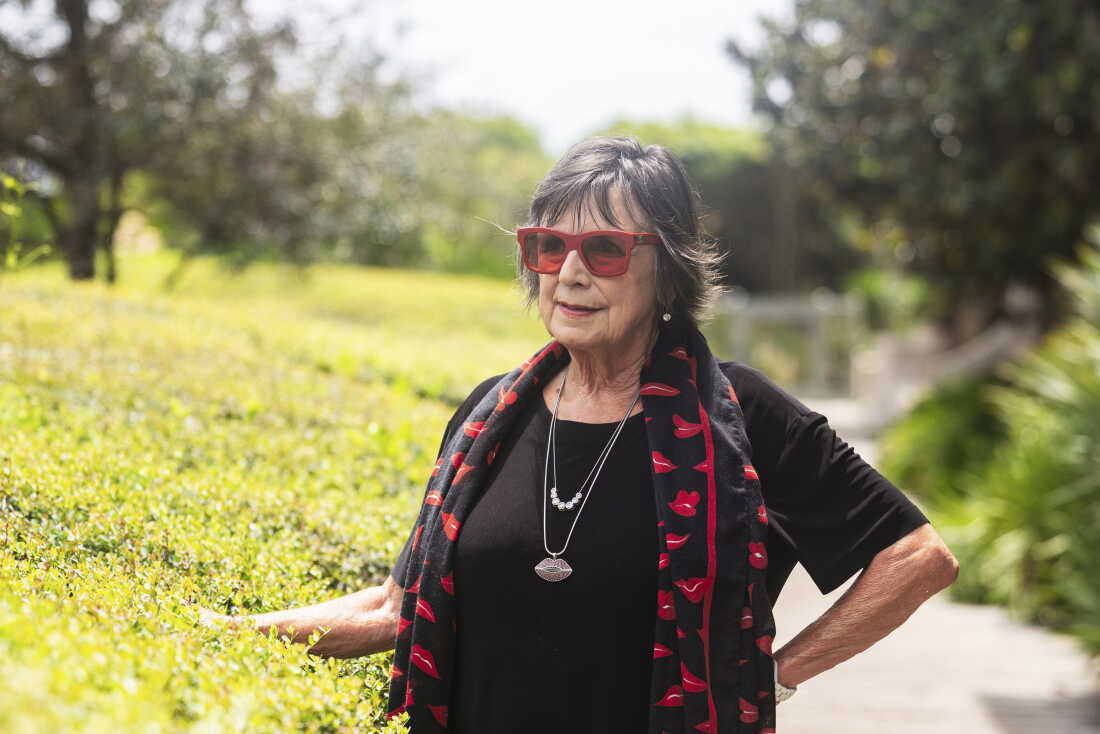
Real estate agent Linda Miller says the battle over beach access has affected the housing market on Florida's Gulf Coast.
"I understand those people that pay $40 million for their Gulf-front property don't want Bubba and them out there with a tent," Miller says.
Still, she thinks the no-trespassing signs and security guards have gotten out of hand.
"That beach belongs to God," Miller says. "You can buy it, but you can't own it."
Some private landowners have proposed a beach-share program in exchange for tax breaks but haven't come to terms with the county. Other proposed solutions include a beach renourishment project that would pump new sand onshore, creating additional public beach property.
Public beach advocates say a statewide fix is the answer.
"We need a constitutional amendment in Florida that will guarantee all of Florida's beaches are public," says Rauschkolb, of Florida Beaches for All, citing similar laws in Oregon, Texas and Hawaii.
"If there ever was a state in our nation that should have public beaches everywhere, it should be Florida."
It has also become ground zero in a protracted battle over where personal property lines end and the public's right to set up a chair and umbrella begin.
The decade-long fight — including the defeat of county efforts to keep the sand open to all, flip-flopping state laws and landowner lawsuits — has left beachgoers to navigate a confusing patchwork of beach access.
As the conflict spreads to other coastal communities, residents in the Sunshine State are eyeing a Florida constitutional amendment to settle the issue once and for all — and to warn beach lovers elsewhere that they may be next.
"Our beaches should be public," says Dave Rauschkolb, a founder of the nonprofit group Florida Beaches for All. "They should be shared as they have for eons."
Rauschkolb walks down a boardwalk at a neighborhood access point that leads to a pocket of public beach sandwiched between multimillion-dollar Gulf front homes.
Dave Rauschkolb, the owner of Bud & Alley's restaurant in Seaside, Fla., helped found the non-profit Florida Beaches for All to advocate for open beaches.
"On a busy day, this will just be packed between the signs," he says, pointing out no-trespassing and private-beach signs that border the public beach.
Security guards posted under red umbrellas greet beachgoers as they descend the boardwalk. Surrounding landowners have hired them to keep people from spilling over onto their beaches.
Rauschkolb, a restaurateur who grew up surfing nearby, says that's just wrong.
"What we're fighting for is the right for people to go to a public access and walk as far as they want with their beach chairs and set up on any beach," he says.
But homeowners, like Eric Wilhelm, an entrepreneur from Marietta, Ga., who spends about half his time at his beach house here, say that this encroaches on their constitutionally protected property rights.
"It's the foundational rule of the way that we live in this freedom-loving country of ours," he says. "Once that breaks down, then we have anarchy and chaos."
Enjoying a cigar from the deck of his home on stilts, Wilhelm looks out over the sugar white sand and glistening Gulf, recalling how his family was drawn here in the 1990s for the seclusion and low-density development. But now, he says, it has become something quite different.
"You're sitting at ground zero of the beach wars."
"No trespassing" signs and private security guards are prevalent along the 26-mile shoreline in south Walton County as disputes have escalated between beachgoers and property owners.
The area has experienced explosive growth. There's not enough public beach space for all the new residents and tourists, Wilhelm says, so they end up on his property and, sometimes, not just to sit in the sand.
He has surveillance cameras set up and says he has called the sheriff about people trespassing.
"There will be people downstairs with cars parked in our driveway. They put a table underneath our house," he says. "They'll just set up a little afternoon cocktail party just because there's nobody in the house."
The fight over sand
Eric Wilhelm, an entrepreneur from Marietta, Ga., spends about half his time at his beach house in Florida and has called the sheriff about beachgoers trespassing on his property. He says claiming private land for public use amounts to communism.
Eric Wilhelm
Wilhelm is among the property owners who prevailed in a protracted legal battle with Walton County over beach access. The conflict has been escalating for a decade, dating to when the county commission passed a customary-use ordinance, declaring the public right to all beaches that had traditionally been used for recreation.
That's when some politically connected homeowners, including former Arkansas Gov. Mike Huckabee, complained. And the Florida Legislature passed a 2018 law that required the county to sue landowners to prove customary use.
Tallahassee attorney Kent Safriet represented some 80 landowners, including Wilhelm. Safriet says customary use is a concept derived from English law that does not square with the U.S. Constitution.
"The Fifth Amendment [says] no private property can be used for public purposes without just compensation," Safriet says. "So, it's in our view that the English doctrine of customary use would be unconstitutional in America."
He says the whole fight boils down to control.
"The county wants to control the beach, and I understand why," says Safriet. "But the county has not recognized thus far that the beach is private and these private property owners have property rights on the beach, no different than the county commissioners have in their front yard."
Last year, the Florida Legislature repealed its 2018 law under public pressure to protect beach access, but Walton County had already settled with landowners over the customary-use issue. At the same time, some landowners have gone to court to claim quiet title to the sand behind their homes.
What's left is ambiguity, says Walton County Sheriff Michael Adkinson Jr., and his deputies are caught in the middle.
"To someone who is in favor of the beaches being open to everybody, they say the sheriff's office are jackbooted thugs," Adkinson says. "People that own the private property say we're godless, liberal communists who allow everybody to go on their beach."
A gate grants keypad access to the beach near the Coleman Pavilion obelisk in Seaside.
Beachgoers in Rosemary Beach, one of several communities that have experienced explosive growth in the last decade.
Adkinson, who has been sheriff since 2009, says he's getting more calls than ever over beach disputes. But deputies, he says, aren't in a position to legally judge property boundaries.
"First of all, we don't know whether the property is private. We don't know whether you actually have legal guardianship of it. We don't know what the legal boundaries of the property are," Adkinson says. "There's a lot to ascertain."
So they mostly just try to lower the temperature when there's a standoff.
"In a decade, I don't think we've made an arrest for trespassing on the beach, because we've been able to resolve these."
The sheriff is being sued for not enforcing the law by Brian Littrell, a member of the band the Backstreet Boys. Littrell's beachfront property has become a flash point in the beach battles.
Littrell's attorney, Peter Ticktin, likens the situation to people setting up a barbecue in your backyard and you calling the sheriff to report trespassing.
"And if the sheriffs came and talked to the people but didn't even tell them that they have to leave, they are basically part of the problem," says Ticktin.
Littrell has also filed a civil lawsuit for a second time against a 68-year-old woman for trespassing. Her supporters say she was within her rights, sitting in a chair seaward of the mean high-tide line considered public land — roughly where the surf laps the shore.
Beach battle lines
On a recent afternoon at high tide, beach activist Sara Day points out where the dividing line is.
"The tide is coming up right now," she says. "So you can see you don't have a lot of space, but you can see all that wet sand over there. You can be there."
Day has created an app called Shoreline Defender that helps people find the mean high-tide line on Florida beaches.
"It is not telling you to trespass," she says. "It is giving you a bandwidth of how much sand you might have at any given time."
She was motivated to develop the free app after a private security guard tried to kick her family off a beach. She says the problem is exacerbated by local concessionaires whom the county allows to set up beach chair rentals along the water line in prime areas.
Beach activist Sara Day created an app called Shoreline Defender to help people figure out where you can set up a beach chair and umbrella along Florida beaches.
Day says a beach should bring solace, not conflict. But she's only seeing the situation escalate.
"It's very important to make the distinction that if you live in a coastal community anywhere in the United States, you need to be watching this, because we never thought it would happen here. But here we are," she says. "You need to be on high alert."
Indeed, similar conflicts are brewing elsewhere in Florida, and that has led to a grassroots campaign for a state constitutional amendment allowing public beach access from the dune line to the water.
Real estate agent Linda Miller says Walton County should have been preserving more public beach space long ago. The county's population has more than doubled since 2000, and its beaches drew more than 4.5 million visitors last year, according to the county tourism office.
"Everybody wants to be here, and the infrastructure has not been developed for everyone to be here," says Miller, who has witnessed the boom in her 28 years as a real estate agent here and is known as the Smile of 30A.
The battle over access has upended her business, making it harder to sell properties not directly on the Gulf, because clients worry that they or their renters won't be able to get a spot on the prized beaches. She gets the dilemma.
Real estate agent Linda Miller says the battle over beach access has affected the housing market on Florida's Gulf Coast.
"I understand those people that pay $40 million for their Gulf-front property don't want Bubba and them out there with a tent," Miller says.
Still, she thinks the no-trespassing signs and security guards have gotten out of hand.
"That beach belongs to God," Miller says. "You can buy it, but you can't own it."
Some private landowners have proposed a beach-share program in exchange for tax breaks but haven't come to terms with the county. Other proposed solutions include a beach renourishment project that would pump new sand onshore, creating additional public beach property.
Public beach advocates say a statewide fix is the answer.
"We need a constitutional amendment in Florida that will guarantee all of Florida's beaches are public," says Rauschkolb, of Florida Beaches for All, citing similar laws in Oregon, Texas and Hawaii.
"If there ever was a state in our nation that should have public beaches everywhere, it should be Florida."
