

Since the discussion is on-topic, here is an intellectually honest look at the war on terrorism. This is an article I saved from 9/12/06.
The U.S. War, Five Years On
By George Friedman
It has been five years since the Sept. 11 attacks. In thinking about the course of the war against al Qaeda, two facts emerge pre-eminent.
The first is that the war has succeeded far better than anyone would have thought on Sept. 12, 2001. We remember that day clearly, and had anyone told us that there would be no more al Qaeda attacks in the United States for at least five years, we would have been incredulous. Yet there have been no attacks.
The second fact is that the U.S. intervention in the Islamic world has not achieved its operational goals. There are multiple insurgencies under way in Iraq, and the United States does not appear to have sufficient force or strategic intent to suppress them. In Afghanistan, the Taliban has re-emerged as a powerful fighting force. It is possible that the relatively small coalition force -- a force much smaller than that fielded by the defeated Soviets in Afghanistan -- can hold it at bay, but clearly coalition troops cannot annihilate it.
A Strategic Response
The strategic goal of the United States on Sept. 12, 2001, was to prevent any further attacks within the United States. Al Qaeda, defined as the original entity that orchestrated the 1998 attacks against the U.S. embassies in Africa, the USS Cole strike and 9/11, has been thrown into disarray and has been unable to mount a follow-on attack without being detected and disrupted. Other groups, loosely linked to al Qaeda or linked only by name or shared ideology, have carried out attacks, but none have been as daring and successful as 9/11.
In response to 9/11, the United States resorted to direct overt and covert intervention throughout the Islamic world. With the first intervention, in Afghanistan, the United States and coalition forces disrupted al Qaeda's base of operations, destabilized the group and forced it on the defensive. Here also, the stage was set for a long guerrilla war that the United States cannot win with the forces available.
The invasion of Iraq, however incoherent the Bush administration's explanation of it might be, achieved two things. First, it convinced Saudi Arabia of the seriousness of American resolve and caused the Saudis to become much more aggressive in cooperating with U.S. intelligence. Second, it allowed the United States to occupy the most strategic ground in the Middle East -- bordering on Kuwait, Saudi Arabia, Jordan, Syria and Iran. From here, the United States was able to pose overt threats and to stage covert operations against al Qaeda. Yet by invading Iraq, the United States also set the stage for the current military crisis.
The U.S. strategy was to disrupt al Qaeda in three ways:
1. Bring the intelligence services of Muslim states -- through persuasion, intimidation or coercion -- to provide intelligence that was available only to them on al Qaeda's operations.
2. By invading Afghanistan and Iraq, use main force to disrupt al Qaeda and to intimidate and coerce Islamic states. In other words, use Operation 2 to achieve Operation 1.
3. Use the intelligence gained by these methods to conduct a range of covert operations throughout the world, including in the United States itself, to disrupt al Qaeda operations.
The problem, however, was this. The means used to compel cooperation with the intelligence services in countries such as Pakistan or Saudi Arabia involved actions that, while successful in the immediate intent, left U.S. forces exposed on a battleground where the correlation of forces, over time, ceased to favor the United States. In other words, while the invasions of Afghanistan and Iraq did achieve their immediate ends and did result in effective action against al Qaeda, the outcome was to expose the U.S. forces to exhausting counterinsurgency that they were not configured to win.
Hindsight: The Search for an Ideal Strategy
The ideal outcome likely would have been to carry out the first and third operations without the second. As many would argue, an acceptable outcome would have been to carry out the Afghanistan operation without going into Iraq. This is the crux of the debate that has been raging since the Iraq invasion and that really began earlier, during the Afghan war, albeit in muted form. On the one side, the argument is that by invading Muslim countries, the United States has played into al Qaeda's hands and actually contributed to radicalization among Islamists -- and that by refraining from invasion, the Americans would have reduced the threat posed by al Qaeda. On the other side, the argument has been made that without these two invasions -- the one for direct tactical reasons, the other for psychological and political reasons -- al Qaeda would be able to operate securely and without effective interference from U.S. intelligence and that, therefore, these invasions were the price to be paid.
There are three models, then, that have been proposed as ideals:
1. The United States should have invaded neither Afghanistan nor Iraq, but instead should have relied entirely on covert measures (with various levels of restraint suggested) to defeat al Qaeda.
2. The United States should have invaded Afghanistan to drive out al Qaeda and disrupt the organization, but should not have invaded Iraq.
3. The United States needed to invade both Iraq and Afghanistan -- the former for strategic reasons and to intimidate key players, the latter to disrupt al Qaeda operations and its home base.
It is interesting to pause and consider that the argument is rarely this clear-cut. Those arguing for Option 1 rarely explain how U.S. covert operations would be carried out, and frequently oppose those operations as well. Those who make the second argument fail to explain how, given that the command cell of al Qaeda had escaped Afghanistan, the United States would continue the war -- or more precisely, where the Americans would get the intelligence to fight a covert war. Those who argue for the third course -- the Bush administration -- rarely explain precisely what the strategic purpose of the war was.
In fact, 9/11 created a logic that drove the U.S. responses. Before any covert war could be launched, al Qaeda's operational structure had to be disrupted -- at the very least, to buy time before another attack. Therefore, an attack in Afghanistan had to come first (and did, commencing about a month after 9/11). Calling this an invasion, of course, would be an error: The United States borrowed forces from Russian and Iranian allies in Afghanistan -- and that, coupled with U.S. air power, forced the Taliban out of the cities to disperse, regroup and restart the war later.
Covert War and a Logical Progression
The problem that the United States had with commencing covert operations against al Qaeda was weakness in its intelligence system. To conduct a covert war, you must have excellent intelligence -- and U.S. intelligence on al Qaeda in the wake of 9/11 was not good enough to sustain a global covert effort. The best intelligence on al Qaeda, simply given the nature of the group as well as its ideology, was in the hands of the Pakistanis and the Saudis. At the very least, Islamic governments were more likely to have accumulated the needed intelligence than the CIA was.
The issue was in motivating these governments to cooperate with the U.S. effort. The Saudis in particular were dubious about U.S. will, given previous decades of behavior. Officials in Riyadh frankly were more worried about al Qaeda's behavior within Saudi Arabia if they collaborated with the Americans than they were about the United States acting resolutely. Recall that the Saudis asked U.S. forces to leave Saudi Arabia after 9/11. Changing the kingdom's attitude was a necessary precursor to waging the covert war, just as Afghanistan was a precursor to changing attitudes in Pakistan.
Invading Iraq was a way for the United States to demonstrate will, while occupying strategic territory to bring further pressure against countries like Syria. It was also a facilitator for a global covert war. The information the Saudis started to provide after the U.S. invasion was critical in disrupting al Qaeda operations. And the Saudis did, in fact, pay the price for collaboration: Al Qaeda rose up against the regime, staging its first attack in the kingdom in May 2003, and was repressed.
In this sense, we can see a logical progression. Invading Afghanistan disrupted al Qaeda operations there and forced Pakistani President Gen. Pervez Musharraf to step up cooperation with the United States. Invading Iraq reshaped Saudi thinking and put the United States in a position to pressure neighboring countries. The two moves together increased U.S. intelligence capabilities decisively and allowed it to disrupt al Qaeda.
But it also placed U.S. forces in a strategically difficult position. Any U.S. intervention in Asia, it has long been noted, places the United States at a massive disadvantage. U.S. troops inevitably will be outnumbered. They also will be fighting on an enemy's home turf, far away from everything familiar and comfortable. If forced into a political war, in which the enemy combatants use the local populace to hide themselves -- and if that populace is itself hostile to the Americans -- the results can be extraordinarily unpleasant. Thus, the same strategy that allowed the United States to disrupt al Qaeda also placed U.S. forces in strategically difficult positions in two theaters of operation.
Mission Creep and Crisis
The root problem was that the United States did not crisply define the mission in either Iraq or Afghanistan. Obviously, the immediate purpose was to create an environment in which al Qaeda was disrupted and the intelligence services of Muslim states felt compelled to cooperate with the United States. But by revising the mission upward -- from achieving these goals to providing security to rooting out Baathism and the Taliban, then to providing security against insurgents and even to redefining these two societies as democracies -- the United States overreached. The issue was not whether democracy is desirable; the issue was whether the United States had sufficient forces at hand to reshape Iraqi and Afghan societies in the face of resistance.
If the Americans had not at first expected resistance, they certainly discovered that they were facing it shortly after taking control of the major cities of each country. At that moment, they had to make a basic decision between pursuing the United States' own interests or defining the interest as transforming Afghan and Iraqi society. At the moment Washington chose transformation, it had launched into a task it could not fulfill -- or, if it could fulfill it, would be able to do so only with enormously more force than it placed in either country. When we consider that 300,000 Soviet troops could not subdue Afghanistan, we get a sense of how large a force would have been needed.
The point here is this: The means used by the United States to cripple al Qaeda also created a situation that was inherently dangerous to the United States. Unless the mission had been parsed precisely -- with the United States doing what it needed to do to disrupt al Qaeda but not overreaching itself -- the outcome would be what we see now. It is, of course, easy to say that the United States should have intervened, achieved its goals and left each country in chaos; it is harder to do. Nevertheless, the United States intervened, did not leave the countries and still has chaos. That can be said with hindsight. Acting so callously with foresight is more difficult.
There remains the question of whether the United States could have crippled al Qaeda without invading Iraq -- a move that still would have left Afghanistan in its current state, but which would seem to have been better than the situation now at hand. The answer to that question rests on two elements. First, it is simply not clear that the Saudis' appreciation of the situation, prior to March 2003, would have moved them to cooperate, and extensive diplomacy over the subject prior to the invasion had left the Americans reasonably convinced that the Saudis could do more. Advocates of diplomacy would have to answer the question of what more the United States could have done on that score. Now, perhaps, over time the United States could have developed its own intelligence sources within al Qaeda. But time was exactly what the United States did not have.
But most important, the U.S. leadership underestimated the consequences of an invasion. They set their goals as high as they did because they did not believe that the Iraqis would resist -- and when resistance began, they denied that it involved anything more than the ragtag remnants of the old regime. Their misreading of Iraq was compounded with an extraordinary difficulty in adjusting their thinking as reality unfolded.
But even without the administration's denial, we can see in hindsight that the current crisis was hardwired into the strategy. If the United States wanted to destroy al Qaeda, it had to do things that would suck it into the current situation -- unless it was enormously skilled and nimble, which it certainly was not. In the end, the primary objective -- defending the homeland -- was won at the cost of trying to achieve goals in Iraq and Afghanistan that cannot be achieved.
In the political debate that is raging today in the United States, our view is that both sides are quite wrong. The administration's argument for building democracy in Iraq and Afghanistan misses the point that the United States cannot be successful in this, because it lacks the force to carry out the mission. The administration's critics, who argue that Iraq particularly diverted attention from fighting al Qaeda, fail to appreciate the complex matrix of relationships the United States was trying to adjust with its invasion of Iraq.
The administration is incapable of admitting that it has overreached and led U.S. forces into an impossible position. Its critics fail to understand the intricate connections between the administration's various actions and the failure of al Qaeda to strike inside the United States for five years.
Replies
242
needs to get out more
have a good day off.

Beach Fanatic
Ah, hell, just one before I leave. This was too easy to skip. I can also name a plethora of books on the subject, but they don't quite get the point across like this does. Religion of Peace below.
http://www.google.com/search?hl=en&safe=off&q=Nick+Berg+Video
Also, I'll pass on one more article if I can still find it.
Blah, blah, blah,
Please provide numbers. Remember, YOUR assertion is that the Middle East is a more violent civilization than any other in history.
You will need to provide facts that compare and contrast the levels of violence (murder, death from war, violent crimes) than any other civilization.
Then in order to bring this claim into relevancy, you will need to formulate a position as to why "Islam is the most violent civilization" reinforces your point. (I have no idea what your point is so this is an important issue.)
Edited

SoWal Insider
Well, great to hear from you all, and I'm glad the resident queen is back. I've been sorta busy today, and I won't be anywhere near a computer tomorrow, but I promise, Honest Injun, I'll get to this ASAP. I know each and every bloody one of you want a response from me, so I promise, like a one legged man in an ass kicking competition, I'll get to you if you are patient. In the meantime, I've posted a webpage for an expert on the tolerance on Muslims. And you can peruse the thread where I admit I'm wrong about something. Regards,
The Guy That Is Smarter And Younger Than You
http://www.danielpipes.org/
I think you meant, "The Guy Who is Smarter and Younger than You"
:razz:
http://www.grammarbook.com/grammar/whoVwhVt.asp

Beach Fanatic
I know each and every bloody one of you want a response from me, so I promise, like a one legged man in an ass kicking competition, I'll get to you if you are patient.
I promise I do not want a response from you - perfectly happy to be ignored by you. Speaking only for myself now.....
Thank you.

SoWal Insider
I think you meant, "The Guy Who is Smarter and Younger than You"
:razz:
http://www.grammarbook.com/grammar/whoVwhVt.asp
or "The Guy Who is Smarter and Younger than a Who? :funn:
Edited

Beach Fanatic
Interesting article. My hope is that we can find the qualified person that we need and that will actually accept the job! Of course, it will take more than just one person to solve this problem ~ an administration that would listen would be a start.
http://www.washingtonpost.com/wp-dyn/content/article/2007/04/10/AR2007041001776.html?hpid=topnews
Excellent article Gypsea. (take note 6thGen, it is an article from a well respected newspaper loaded with insight, facts and information, i.e. not an Op-Ed).
In reading the article it does make me wonder whether the Whitehouse may be looking for more of a Scapegoat than a Czar; they need someone that is credible but willing to take the position and then fall on his sword for the Bush/Chaney/Neo-Con cause. Apparently they are not finding too many Generals willing to go for that, although it does make me think that we do need somebody, anybody, but Bush at the helm.
Beach Fanatic
Well, great to hear from you all, and I'm glad the resident queen is back. I've been sorta busy today, and I won't be anywhere near a computer tomorrow, but I promise, Honest Injun, I'll get to this ASAP. I know each and every bloody one of you want a response from me, so I promise, like a one legged man in an ass kicking competition, I'll get to you if you are patient. In the meantime, I've posted a webpage for an expert on the tolerance on Muslims. And you can peruse the thread where I admit I'm wrong about something. Regards,
The Guy That Is Smarter And Younger Than You
http://www.danielpipes.org/
First of all! Way to Go 30-gAy!!!! Knock him down point for point. Excellent!!
:clap_1: I always wanted to be a cheerleader!:clap_1: :clap_1:
Now,
Thanks for the heads up. Do not flatter yourself 6thGin, as you might have noticed, had you been paying attention, no one really takes you seriously.
Meanwhile, while you are gone, the rest of us will enjoy the opportunity to engage in some intelligent discourse. Without being bogged down by the functionally illiterate, we should learn a lot from the insight of those thoughtful, well traveled, well read and well written individuals who shall remain.
A few points to ponder while you are on your hiatus:
? Opinion does NOT Equal Fact.
? A belief is, by definition, not a fact-based understanding, nor is it an arguable point.
? Dragging up, half-baked, propagandistic, self-published ?articles? (i.e. what the rest of us would call an Op-ed piece) from Neo-Conservative websites is not proof of anything other than your abundant lack of, or incapacity to perform, critical thinking.
? A hayseed traveling to the county fair once a year does not make said hayseed well traveled.
I am with you Chickpea. I am all for ignoring the ignorant, and with luck he will ignore us. Now it looks as though we have a one day head start to a better understanding to one of the largest problems of our time.

margarita brocolia
omg bdarg!! You put a huge smile on my face this morning! 😀

and how clever --- 6thgin! :lol: That might answer some questions ......
.
and how clever --- 6thgin! :lol: That might answer some questions ......
.
Edited
Beach Fanatic
I made the point that you have no idea who the Iraqi citizens blame for the problems in the country. .
Oops, looks like your point is getting a bit shaky??
http://www.usatoday.com/news/graphics/iraqpoll/poll6/flash.htm
?Iraqis have differing views of the roles played by outside countries in the conflict. Overall, the United States has the worst image- with 77% of respondents saying they are playing a negative role.?
I would have thought that most people could have understood the logic of this conclusion without having to be beaten over the head with evidence.
Beach Fanatic
Before I am accused of ?moving the goalposts? lets cover all the bases and just look at violence within Iraq.
From ABCNews http://abcnews.go.com/images/US/1033aIraqpoll.pdf
38. Who do you blame the most for the violence that is occurring in the country?
3/5/07
All Sunni Shiite Kurdish
US/coalition forces 31 38 34 8
President Bush 9 12 8 2
Iraqi government 8 13 5 4
Iraqi army 1 3 * 2
Iraqi police 1 2 0 1
Sunni militias/leaders 5 * 8 6
Shiite militias/leaders 6 9 1 14
Sectarian disputes 8 5 7 13
Al Qaeda/foreign jihadis 18 2 28 27
Common criminals 6 3 7 8
The US clearly gets the biggest share of the blame. (Surprised?). When one filters the Kurds out of the poll numbers, (which is within context, since no one in this discussion has advocating being worried about the long term consequences of Bush?s policies towards them) the numbers are even more stark.
Beach Fanatic
I know each and every bloody one of you want a response from me, so I promise, like a one legged man in an ass kicking competition, I'll get to you if you are patient.
Why do I have the distinct feeling this is going to look more like that scene from Monty Python.....
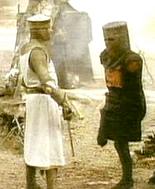
"I can still fight, ...Tis merely an inability to think logically...."
Beach Fanatic
I know several of you have spent time or lived in the Middle East. Based on your experiences, what in your opinion is of the philosophical disconnect between the Middle East and the west that keeps us at such odds? How can we as westerners better understand the collective mind of the Middle East?

Beach Fanatic
I know several of you have spent time or lived in the Middle East. Based on your experiences, what in your opinion is of the philosophical disconnect between the Middle East and the west that keeps us at such odds? How can we as westerners better understand the collective mind of the Middle East?
In my opinion, it isn't a philosophical disconnect between the Middle East and the west that is keeping us at odds.
It is 60 year history of aggressive western involvement in the region which is at the root of animosity. They live under repressive regimes which we support (for our own interests) and they hate us for that. We overthrow their democratically elected governments (google Mossadeq) when it suits our needs and they don't like that much either. After 60 years, the issues become extremely complex and interwoven, but that is the root of the problem here.
There isn't a lot of hostility between say Indonesia (the largest muslim country in population) and the US because there is no history of unwanted involvement there. There isn't a lot of hostitilty between Turkey, again muslim, for the same reason.
That is why I have suggested a policy shift to extricate ourselves (as much as is possible) from the region.
Beach Fanatic
Pentagon report contains major criticisms of administration.
?Late on the Wednesday afternoon before the Thanksgiving holiday, the US Defense Department confirmed the contents of a report by the Defense Science Board that is highly critical of the administration's efforts in the war on terror and in the wars in Iraq and Afghanistan. The report had been originally placed on the DSB's website in early November.?
http://www.msnbc.msn.com/id/6577524/
Also from the article:
Saudi Arabia cited as example
The report cited as an example Saudi Arabia, a longtime U.S. ally and birthplace of Osama bin Laden. A large majority of Saudis believe the United States is trying to weaken Islam, the report said.
?In other words, Americans have become the enemy,? it said. ?It is noteworthy that opinion is (strongest) against America in precisely those places ruled by what Muslims call ?apostates? and tyrants ? the tyrants we support. This should give us pause.?
I?m guessing that the Pentagon report is asking us to ?give pause? in light of this historical example? [ame="http://en.wikipedia.org/wiki/Iranian_Revolution"]http://en.wikipedia.org/wiki/Iranian_Revolution[/ame]
Again, I think this is more strong evidence in support of a MAJOR policy shift in the region.
?Late on the Wednesday afternoon before the Thanksgiving holiday, the US Defense Department confirmed the contents of a report by the Defense Science Board that is highly critical of the administration's efforts in the war on terror and in the wars in Iraq and Afghanistan. The report had been originally placed on the DSB's website in early November.?
'Muslims do not hate our freedom, but rather they hate our policies [the report says]. The overwhelming majority voice their objections to what they see as one-sided support in favor of Israel and against Palestinian rights, and the long-standing, even increasing, support for what Muslims collectively see as tyrannies, most notably Egypt, Saudi Arabia, Jordan, Pakistan and the Gulf states. Thus, when American public diplomacy talks about bringing democracy to Islamic societies, this is seen as no more than self-serving hypocrisy.'
http://www.msnbc.msn.com/id/6577524/
Also from the article:
Saudi Arabia cited as example
The report cited as an example Saudi Arabia, a longtime U.S. ally and birthplace of Osama bin Laden. A large majority of Saudis believe the United States is trying to weaken Islam, the report said.
?In other words, Americans have become the enemy,? it said. ?It is noteworthy that opinion is (strongest) against America in precisely those places ruled by what Muslims call ?apostates? and tyrants ? the tyrants we support. This should give us pause.?
I?m guessing that the Pentagon report is asking us to ?give pause? in light of this historical example? [ame="http://en.wikipedia.org/wiki/Iranian_Revolution"]http://en.wikipedia.org/wiki/Iranian_Revolution[/ame]
Again, I think this is more strong evidence in support of a MAJOR policy shift in the region.
Checking your forum account
Please wait while we verify your forum account.