

COVID19: Opinion and Discussion
- Thread starter Teresa
- Start date
-
Trouble logging in? Send us a message with your username and/or email address for help.
You are using an out of date browser. It may not display this or other websites correctly.
You should upgrade or use an alternative browser.
You should upgrade or use an alternative browser.
New posts


Fauci has been working in the public sector for fifty years. He is not the source to look to regarding economics. How to gin up fear and sell vaccines ,yes. But not economics.
Here’s a good source for economic education Home www.fee.org The Foundation for Economic Education
Part of that approach relies on having access to one of the world’s best-functioning health-care systems. At no stage did Sweden see a real shortage of medical equipment or hospital capacity, and tents set up as emergency care facilities around the country have mostly remained empty.
Also from your link.
Sweden also recently pushed back against the notion that there’s little to no social distancing going on.
“We don’t have a radically different view,” Foreign Minister Ann Linde said in an interview with Radio Sweden. “The government has made a series of decisions that affect the whole society. It’s a myth that life goes on as normal in Sweden.”
I think I'll keep listening to Dr. Fauci, America's Doctor who we've been watching, listening to and learning what we need to know and do to stay safe. Most people I know were social distancing and staying home very early in this process because of his words of wisdom. He knows what he's talking about. He has had outstanding interviews with quite a few news outlets, as well as some more relaxed sit downs with Stephen Colbert and Trevor Noah. Fauci is very down to earth and knows how to explain this pandemic and the necessary measures in realistic terms.
Fauci Says U.S. Coronavirus Deaths May Be 'More Like 60,000'; Antibody Tests On Way
April 9, 202011:12 AM ET
BILL CHAPPELL
4-Minute Listen

"I think the American public have done a really terrific job of just buckling down and doing those physical separation and adhering to those guidelines," National Institute of Allergy and Infectious Diseases Director Dr. Anthony Fauci said Thursday.
Kevin Lamarque/Reuters
The U.S. is enduring a "very bad week" during the COVID-19 pandemic, Dr. Anthony Fauci says. But he also says that the American public's embrace of physical separation and other restrictions is sharply reducing projections of the death toll from the respiratory virus.
The final toll currently "looks more like 60,000 than the 100,000 to 200,000" that U.S. officials previously estimated, Fauci said.
Fauci, America's leading expert on infectious diseases and a key member of the White House's coronavirus task force, also said that antibody tests have been developed and will be available "very soon."
Fauci discussed COVID-19 and its death toll Thursday morning, during a segment of NBC News' Today show.
"The number of deaths and the cases that we're seeing right now are really validating what we said, that this is going to be a very bad week, on the one hand," Fauci said. "On the other hand, as you can see there are some glimmers of hope, particularly when you look at the situation in New York — where the number of hospitalizations, requirements for intensive care and intubation over the last few days have actually stabilized and [are] starting to come down."
"between 100,000 and 200,000" people in the U.S. could die from COVID-19.
The 60,000 figure is reflected in a new projection by the Institute for Health Metrics and Evaluation, or IHME, a research center at the University of Washington. The estimate predicts the U.S. death toll through early August; it also predicts that COVID-19 deaths will peak in this country on April 11.
The revised analysis comes as millions of Americans are living under "shelter in place" and business shutdown orders that have contributed to massive job losses and other disruptions. The pandemic has left many anxiously waiting for the virus to peak in their state.
COVID-19 has now caused nearly 15,000 deaths in the U.S., and more than 430,000 people are infected with the virus, according to a COVID-19 dashboard created by Johns Hopkins University's Whiting School of Engineering, which reports the numbers in near real time. It has also taken a horrible toll on minority communities, particularly African Americans.
New York is the epicenter of COVID-19 in the U.S., with more than 150,000 cases. Despite a recent spike in deaths there, Fauci said there are signs that the state is flattening the curve.
"I don't want to jump the gun on that," Fauci said, "but I think that is the case."
He added, "I'm always very cautious about jumping the gun and saying, 'Well, we have turned the corner.' But I think we are really looking at the beginning of that, which would really be very encouraging. We need that right now."
Another crucial question on many people's minds is when they can take an antibody test, a blood test that can reveal whether someone might have had the new coronavirus without being diagnosed, either before the national alarm was sounded over the outbreak or during the delay in providing enough tests to meet demand.
"The antibody tests are developed, there are several out there," Fauci said. "We are told by the people, the companies that make them, that very soon — when they say soon, they're talking days to weeks — that we'd be able to have a large number of these tests available."
The tests will be important, Fauci said, because "there may be many people out there, and I suspect there are a fair amount, that have been infected, were asymptomatic and didn't know it."
People who have been infected will likely have protection from the coronavirus in the future, he said, while adding that further tests are needed to ensure that is the case with COVID-19.
"You may have a cohort of people who are actually protected, who have more of a chance at getting back into the normality of society," Fauci said.
Such a test will be vital, he added, to health care workers who could do their jobs much better if they know they're protected from the virus.
While he praised the American public's efforts to slow the spread of the coronavirus, Fauci also warned that it's not yet time to stop those measures.
"I think the American public have done a really terrific job of just buckling down and doing those physical separation and adhering to those guidelines," Fauci said on Thursday. "But having said that, we better be careful that we don't say, 'OK, we're doing so well we could pull back.' We still have to put our foot on the accelerator when it comes to the mitigation and the physical separation."

What works in Sweden wouldn't work here. Most people in Sweden are reality based, science minded, and non-faith-based. They don't have #FloridaMorons.
New posts
- Status
- Not open for further replies.
Amid protests, Dr. Anthony Fauci warns reopening U.S. too soon could "backfire."
“Unless we get the virus under control, the real recovery, economically, is not going to happen," he tells @GStephanopoulos. Coronavirus updates: Cuomo says 'we are going through hell'
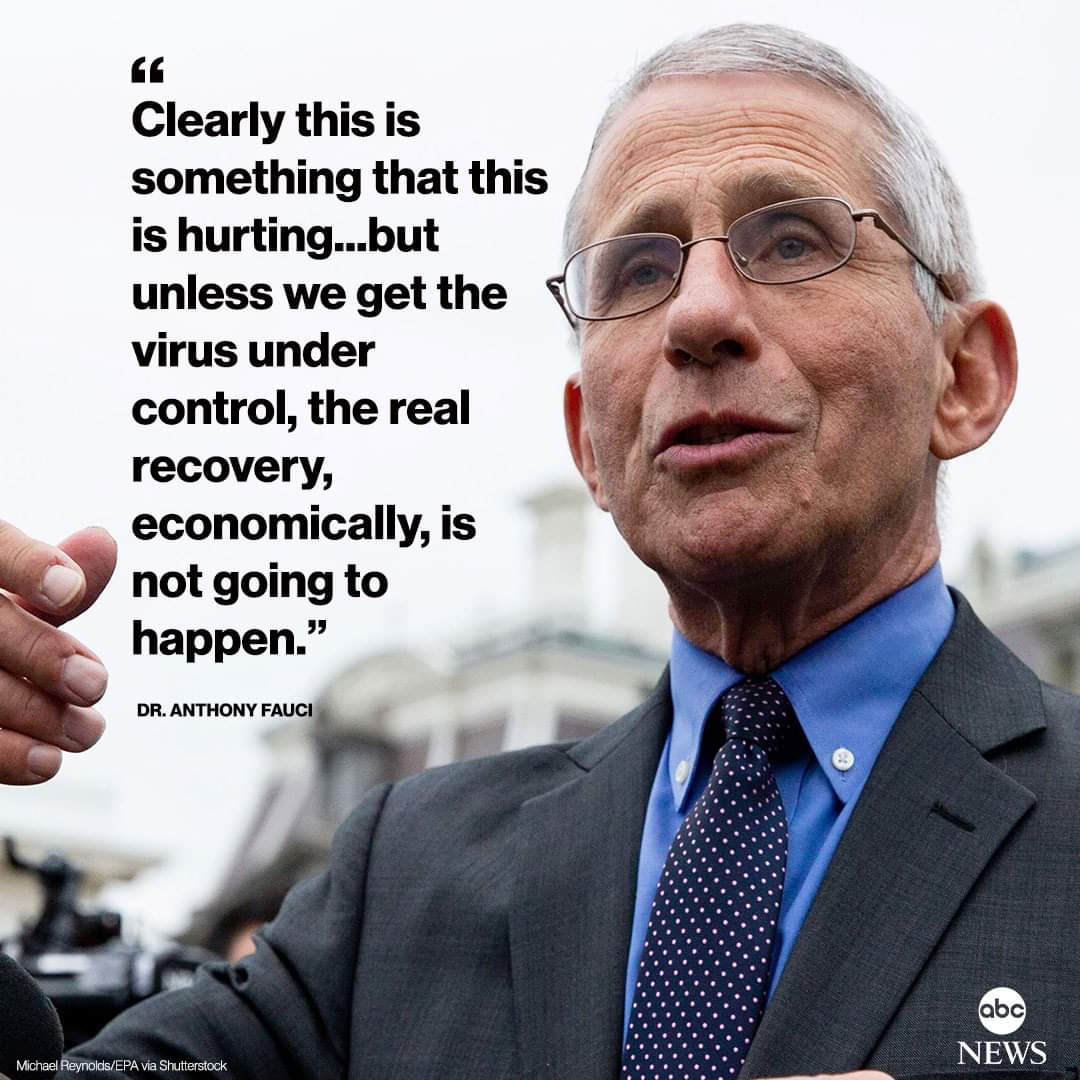
“Unless we get the virus under control, the real recovery, economically, is not going to happen," he tells @GStephanopoulos. Coronavirus updates: Cuomo says 'we are going through hell'

https://www.bloomberg.com/news/articles/2020-04-19/sweden-says-controversial-covid-19-strategy-is-proving-effective
https://www.bloomberg.com/news/arti...ersial-covid-19-strategy-is-proving-effective
Sweden Says Controversial Virus Strategy Proving Effective
Sweden may be on to something. Bloomberg reports:
Sweden’s unusual approach to fighting the coronavirus pandemic is starting to yield results, according to the country’s top epidemiologist.
Anders Tegnell, the architect behind Sweden’s relatively relaxed response to Covid-19, told local media the latest figures on infection rates and fatalities indicate the situation is starting to stabilize.
“We’re on a sort of plateau,” Tegnell told Swedish news agency TT.
If Tegnell’s characterization turns out to be true, it will be quite a vindication for Sweden, which has been widely denounced for bucking the trend among governments of imposing draconian “shelter-at-home” decrees that have crippled the world economy and thrown millions out of work.
While fear of the COVID-19 pandemic has driven the citizens of many countries around the world to be extremely trusting of their governments’ information, predictions, advice, and edicts, the Swedish government flipped the script by placing its trust in its citizens. As the Bloomberg report puts it (emphasis added):
Sweden has left its schools, gyms, cafes, bars and restaurants open throughout the spread of the pandemic. Instead, the government has urged citizens to act responsibly and follow social distancing guidelines.
The Swedish people have lived up to that trust, and have appreciated it:
Yet overall, Lofven’s strategy has won the approval of Swedes, and his personal popularity has soared.
“I have very high confidence in the Swedish authorities that manage this,” Volvo Cars CEO Hakan Samuelsson said in a phone interview. “It’s a hard balance to strike, but I have full confidence in the measures that Sweden has taken.”
Volvo, which was forced to halt production across Europe and furlough about 20,000 Swedish employees, will resume production at its Swedish plants on Monday.
“Our measures are all based on individuals taking responsibility, and that is also an important part of the Swedish model,” Samuelsson said.
Measures based on individual responsibility used to be part of the American model, too, as codified in the Bill of Rights. Yet we have developed a culture of reflexively giving up that responsibility and those rights whenever we get scared: of terrorists, of economic hardship, of a virus. As the economic devastation from our latest collective panic attack mounts, we are seeing how counterproductive that cowering posture can be.
If we are going to recover from this anytime soon, Americans must rediscover our founding principles. And people all around the world must insist that their governments place at least as much trust in its citizens as Sweden has. But to do that, we must first learn to trust ourselves as a society of individuals. And to do that, it would help to learn some economics: especially the concept of spontaneous order.
https://www.bloomberg.com/news/arti...ersial-covid-19-strategy-is-proving-effective
Sweden Says Controversial Virus Strategy Proving Effective
Sweden may be on to something. Bloomberg reports:
Sweden’s unusual approach to fighting the coronavirus pandemic is starting to yield results, according to the country’s top epidemiologist.
Anders Tegnell, the architect behind Sweden’s relatively relaxed response to Covid-19, told local media the latest figures on infection rates and fatalities indicate the situation is starting to stabilize.
“We’re on a sort of plateau,” Tegnell told Swedish news agency TT.
If Tegnell’s characterization turns out to be true, it will be quite a vindication for Sweden, which has been widely denounced for bucking the trend among governments of imposing draconian “shelter-at-home” decrees that have crippled the world economy and thrown millions out of work.
While fear of the COVID-19 pandemic has driven the citizens of many countries around the world to be extremely trusting of their governments’ information, predictions, advice, and edicts, the Swedish government flipped the script by placing its trust in its citizens. As the Bloomberg report puts it (emphasis added):
Sweden has left its schools, gyms, cafes, bars and restaurants open throughout the spread of the pandemic. Instead, the government has urged citizens to act responsibly and follow social distancing guidelines.
The Swedish people have lived up to that trust, and have appreciated it:
Yet overall, Lofven’s strategy has won the approval of Swedes, and his personal popularity has soared.
“I have very high confidence in the Swedish authorities that manage this,” Volvo Cars CEO Hakan Samuelsson said in a phone interview. “It’s a hard balance to strike, but I have full confidence in the measures that Sweden has taken.”
Volvo, which was forced to halt production across Europe and furlough about 20,000 Swedish employees, will resume production at its Swedish plants on Monday.
“Our measures are all based on individuals taking responsibility, and that is also an important part of the Swedish model,” Samuelsson said.
Measures based on individual responsibility used to be part of the American model, too, as codified in the Bill of Rights. Yet we have developed a culture of reflexively giving up that responsibility and those rights whenever we get scared: of terrorists, of economic hardship, of a virus. As the economic devastation from our latest collective panic attack mounts, we are seeing how counterproductive that cowering posture can be.
If we are going to recover from this anytime soon, Americans must rediscover our founding principles. And people all around the world must insist that their governments place at least as much trust in its citizens as Sweden has. But to do that, we must first learn to trust ourselves as a society of individuals. And to do that, it would help to learn some economics: especially the concept of spontaneous order.
Amid protests, Dr. Anthony Fauci warns reopening U.S. too soon could "backfire."
“Unless we get the virus under control, the real recovery, economically, is not going to happen," he tells @GStephanopoulos. Coronavirus updates: Cuomo says 'we are going through hell'
View attachment 83045
Fauci has been working in the public sector for fifty years. He is not the source to look to regarding economics. How to gin up fear and sell vaccines ,yes. But not economics.
Here’s a good source for economic education Home www.fee.org The Foundation for Economic Education
BINGO!! Comphensive Universal Healthcare for every man, woman, and child.https://www.bloomberg.com/news/articles/2020-04-19/sweden-says-controversial-covid-19-strategy-is-proving-effective
Sweden Says Controversial Virus Strategy Proving Effective
Sweden may be on to something. Bloomberg reports:
Sweden’s unusual approach to fighting the coronavirus pandemic is starting to yield results, according to the country’s top epidemiologist.
Anders Tegnell, the architect behind Sweden’s relatively relaxed response to Covid-19, told local media the latest figures on infection rates and fatalities indicate the situation is starting to stabilize.
“We’re on a sort of plateau,” Tegnell told Swedish news agency TT.
If Tegnell’s characterization turns out to be true, it will be quite a vindication for Sweden, which has been widely denounced for bucking the trend among governments of imposing draconian “shelter-at-home” decrees that have crippled the world economy and thrown millions out of work.
While fear of the COVID-19 pandemic has driven the citizens of many countries around the world to be extremely trusting of their governments’ information, predictions, advice, and edicts, the Swedish government flipped the script by placing its trust in its citizens. As the Bloomberg report puts it (emphasis added):
Sweden has left its schools, gyms, cafes, bars and restaurants open throughout the spread of the pandemic. Instead, the government has urged citizens to act responsibly and follow social distancing guidelines.
The Swedish people have lived up to that trust, and have appreciated it:
Yet overall, Lofven’s strategy has won the approval of Swedes, and his personal popularity has soared.
“I have very high confidence in the Swedish authorities that manage this,” Volvo Cars CEO Hakan Samuelsson said in a phone interview. “It’s a hard balance to strike, but I have full confidence in the measures that Sweden has taken.”
Volvo, which was forced to halt production across Europe and furlough about 20,000 Swedish employees, will resume production at its Swedish plants on Monday.
“Our measures are all based on individuals taking responsibility, and that is also an important part of the Swedish model,” Samuelsson said.
Measures based on individual responsibility used to be part of the American model, too, as codified in the Bill of Rights. Yet we have developed a culture of reflexively giving up that responsibility and those rights whenever we get scared: of terrorists, of economic hardship, of a virus. As the economic devastation from our latest collective panic attack mounts, we are seeing how counterproductive that cowering posture can be.
If we are going to recover from this anytime soon, Americans must rediscover our founding principles. And people all around the world must insist that their governments place at least as much trust in its citizens as Sweden has. But to do that, we must first learn to trust ourselves as a society of individuals. And to do that, it would help to learn some economics: especially the concept of spontaneous order.
Part of that approach relies on having access to one of the world’s best-functioning health-care systems. At no stage did Sweden see a real shortage of medical equipment or hospital capacity, and tents set up as emergency care facilities around the country have mostly remained empty.
Also from your link.
Sweden also recently pushed back against the notion that there’s little to no social distancing going on.
“We don’t have a radically different view,” Foreign Minister Ann Linde said in an interview with Radio Sweden. “The government has made a series of decisions that affect the whole society. It’s a myth that life goes on as normal in Sweden.”
Last edited:

More deaths, no benefit from malaria drug in VA virus study
A malaria drug widely touted by President Donald Trump for treating the new coronavirus showed no benefit in a large analysis of its use in U.S. veterans hospitals. There were more deaths among those given hydroxychloroquine versus standard care, researchers reported.
A malaria drug widely touted by President Donald Trump for treating the new coronavirus showed no benefit in a large analysis of its use in U.S. veterans hospitals. There were more deaths among those given hydroxychloroquine versus standard care, researchers reported.
Fauci has been working in the public sector for fifty years. He is not the source to look to regarding economics. How to gin up fear and sell vaccines ,yes. But not economics.
I think I'll keep listening to Dr. Fauci, America's Doctor who we've been watching, listening to and learning what we need to know and do to stay safe. Most people I know were social distancing and staying home very early in this process because of his words of wisdom. He knows what he's talking about. He has had outstanding interviews with quite a few news outlets, as well as some more relaxed sit downs with Stephen Colbert and Trevor Noah. Fauci is very down to earth and knows how to explain this pandemic and the necessary measures in realistic terms.
Fauci Says U.S. Coronavirus Deaths May Be 'More Like 60,000'; Antibody Tests On Way
April 9, 202011:12 AM ET
BILL CHAPPELL
4-Minute Listen
"I think the American public have done a really terrific job of just buckling down and doing those physical separation and adhering to those guidelines," National Institute of Allergy and Infectious Diseases Director Dr. Anthony Fauci said Thursday.
Kevin Lamarque/Reuters
The U.S. is enduring a "very bad week" during the COVID-19 pandemic, Dr. Anthony Fauci says. But he also says that the American public's embrace of physical separation and other restrictions is sharply reducing projections of the death toll from the respiratory virus.
The final toll currently "looks more like 60,000 than the 100,000 to 200,000" that U.S. officials previously estimated, Fauci said.
Fauci, America's leading expert on infectious diseases and a key member of the White House's coronavirus task force, also said that antibody tests have been developed and will be available "very soon."
Fauci discussed COVID-19 and its death toll Thursday morning, during a segment of NBC News' Today show.
"The number of deaths and the cases that we're seeing right now are really validating what we said, that this is going to be a very bad week, on the one hand," Fauci said. "On the other hand, as you can see there are some glimmers of hope, particularly when you look at the situation in New York — where the number of hospitalizations, requirements for intensive care and intubation over the last few days have actually stabilized and [are] starting to come down."
"between 100,000 and 200,000" people in the U.S. could die from COVID-19.
The 60,000 figure is reflected in a new projection by the Institute for Health Metrics and Evaluation, or IHME, a research center at the University of Washington. The estimate predicts the U.S. death toll through early August; it also predicts that COVID-19 deaths will peak in this country on April 11.
The revised analysis comes as millions of Americans are living under "shelter in place" and business shutdown orders that have contributed to massive job losses and other disruptions. The pandemic has left many anxiously waiting for the virus to peak in their state.
COVID-19 has now caused nearly 15,000 deaths in the U.S., and more than 430,000 people are infected with the virus, according to a COVID-19 dashboard created by Johns Hopkins University's Whiting School of Engineering, which reports the numbers in near real time. It has also taken a horrible toll on minority communities, particularly African Americans.
New York is the epicenter of COVID-19 in the U.S., with more than 150,000 cases. Despite a recent spike in deaths there, Fauci said there are signs that the state is flattening the curve.
"I don't want to jump the gun on that," Fauci said, "but I think that is the case."
He added, "I'm always very cautious about jumping the gun and saying, 'Well, we have turned the corner.' But I think we are really looking at the beginning of that, which would really be very encouraging. We need that right now."
Another crucial question on many people's minds is when they can take an antibody test, a blood test that can reveal whether someone might have had the new coronavirus without being diagnosed, either before the national alarm was sounded over the outbreak or during the delay in providing enough tests to meet demand.
"The antibody tests are developed, there are several out there," Fauci said. "We are told by the people, the companies that make them, that very soon — when they say soon, they're talking days to weeks — that we'd be able to have a large number of these tests available."
The tests will be important, Fauci said, because "there may be many people out there, and I suspect there are a fair amount, that have been infected, were asymptomatic and didn't know it."
People who have been infected will likely have protection from the coronavirus in the future, he said, while adding that further tests are needed to ensure that is the case with COVID-19.
"You may have a cohort of people who are actually protected, who have more of a chance at getting back into the normality of society," Fauci said.
Such a test will be vital, he added, to health care workers who could do their jobs much better if they know they're protected from the virus.
While he praised the American public's efforts to slow the spread of the coronavirus, Fauci also warned that it's not yet time to stop those measures.
"I think the American public have done a really terrific job of just buckling down and doing those physical separation and adhering to those guidelines," Fauci said on Thursday. "But having said that, we better be careful that we don't say, 'OK, we're doing so well we could pull back.' We still have to put our foot on the accelerator when it comes to the mitigation and the physical separation."


https://www.bloomberg.com/news/articles/2020-04-19/sweden-says-controversial-covid-19-strategy-is-proving-effective
Sweden Says Controversial Virus Strategy Proving Effective
Sweden may be on to something. Bloomberg reports:
Sweden’s unusual approach to fighting the coronavirus pandemic is starting to yield results, according to the country’s top epidemiologist.
Anders Tegnell, the architect behind Sweden’s relatively relaxed response to Covid-19, told local media the latest figures on infection rates and fatalities indicate the situation is starting to stabilize.
“We’re on a sort of plateau,” Tegnell told Swedish news agency TT.
If Tegnell’s characterization turns out to be true, it will be quite a vindication for Sweden, which has been widely denounced for bucking the trend among governments of imposing draconian “shelter-at-home” decrees that have crippled the world economy and thrown millions out of work.
While fear of the COVID-19 pandemic has driven the citizens of many countries around the world to be extremely trusting of their governments’ information, predictions, advice, and edicts, the Swedish government flipped the script by placing its trust in its citizens. As the Bloomberg report puts it (emphasis added):
Sweden has left its schools, gyms, cafes, bars and restaurants open throughout the spread of the pandemic. Instead, the government has urged citizens to act responsibly and follow social distancing guidelines.
The Swedish people have lived up to that trust, and have appreciated it:
Yet overall, Lofven’s strategy has won the approval of Swedes, and his personal popularity has soared.
“I have very high confidence in the Swedish authorities that manage this,” Volvo Cars CEO Hakan Samuelsson said in a phone interview. “It’s a hard balance to strike, but I have full confidence in the measures that Sweden has taken.”
Volvo, which was forced to halt production across Europe and furlough about 20,000 Swedish employees, will resume production at its Swedish plants on Monday.
“Our measures are all based on individuals taking responsibility, and that is also an important part of the Swedish model,” Samuelsson said.
Measures based on individual responsibility used to be part of the American model, too, as codified in the Bill of Rights. Yet we have developed a culture of reflexively giving up that responsibility and those rights whenever we get scared: of terrorists, of economic hardship, of a virus. As the economic devastation from our latest collective panic attack mounts, we are seeing how counterproductive that cowering posture can be.
If we are going to recover from this anytime soon, Americans must rediscover our founding principles. And people all around the world must insist that their governments place at least as much trust in its citizens as Sweden has. But to do that, we must first learn to trust ourselves as a society of individuals. And to do that, it would help to learn some economics: especially the concept of spontaneous order.
What works in Sweden wouldn't work here. Most people in Sweden are reality based, science minded, and non-faith-based. They don't have #FloridaMorons.
- Status
- Not open for further replies.