• Trouble logging in? Send us a message with your username and/or email address for help.

Other Destin-Fort Walton Beach Wants to be Dive Capital of Florida

New posts
Okaloosa County Commissioners unanimously approved a $2.95 million contract amendment Tuesday to complete the remediation and deployment of the SS United States as the world’s largest artificial reef, with officials emphasizing that partner contributions totaling more than $4 million will offset the additional costs. No additional Okaloosa County funds proposed in this amendment.

Alex Fogg, the county’s Natural Resources Chief, presented a detailed project update before requesting the funding increase, outlining both the progress made and the challenges encountered in preparing the 990-foot historic ocean liner for its new life in the Gulf.

Fogg explained that approximately $2.2 million of the $2.95 million request stems from unexpected but necessary overruns when planning to depart Philadelphia, with the remainder covering additional needs to reach the finish line, including dockage through June 1 and contingency funds.

The vessel, which still holds the transatlantic speed record more than 70 years after its maiden voyage, is currently docked in Mobile, Alabama, undergoing final remediation following a 1,600-mile tow from Philadelphia that took approximately 12 days.

Fogg provided a comprehensive project update, addressing public concerns while securing final funding for the project.

Remediation is over 90% complete, with all 120 fuel tanks emptied and cleaned and 99% of PCB-containing materials removed.
The ship's iconic funnels, radar mast and five-blade propeller have been removed and stored for the future land-based museum.
Deployment is targeted for late February 2026, with 30-day contingency windows built in for weather.
The EPA has made two site visits and expressed satisfaction with remediation work.
Fogg addressed concerns about zinc chromate and hexavalent chromium, noting regulatory agencies have not raised concerns.
The project has generated $184 million in earned media value since November 2024.
Research partnerships established with Woods Hole Oceanographic Institution, Dauphin Island Sea Lab and Louisiana State University for 10-year monitoring.
The SS United States Conservancy chose Okaloosa County over a higher offer to scrap the vessel.
 
Okaloosa County is one step closer to sinking the SS United States off the coast of Destin after a procedural vote passed the Okaloosa Board of County Commissioners on Tuesday.

Despite the Army Corps of Engineers’ finding that sinking the National Register-listed vessel will have an “adverse effect,” a Memorandum of Agreement was approved on April 21 at the Okaloosa County Board of County Commissioners Meeting. The agreement permits the U.S. Army Corps of Engineers, the Florida State Historic Preservation Office, and Okaloosa County to proceed under Federal law.

The Commissioners’ votes allowed the SS United States artificial reef project to clear one of the last hurdles between the Okaloosa Tourism Department’s vision and reality – the Army Corps of Engineers’ Section 106 Review. The review, required by Section 106 of the National Historic Preservation Act of 1966, allows critique and public comment on proposals that involve the federal government and historic land, objects, buildings, or other cultural heritage places.

“The 15-day comment period is technically over as it started the day the Army Corps sent out the notice, which was April 7. The MOA was approved, as you know, by the Okaloosa County Board of County Commissioners [Tuesday, April 21],” said Nick Tomecek, Okaloosa County’s Public Information Officer. “So that is a great next step in the deployment of the vessel. We still need to submit our report to the EPA for final approval, and then we will take the next steps in the planning process for deployment.”

What Happens Now

Before sinking takes place, Okaloosa County has agreed to 3D scans and photos, as well as documentation of the parts removed. The County or its representatives will also survey the ocean floor. Once in the water, the SSUS will be studied, mapped, and preserved.

After sinking, the County will create a 3D dive model. Think of it as Google Street View for shipwrecks. The agreement also includes an effort to maintain the vessel’s listing on the National Register of Historic Places. Keeping the ship on the register may be tricky, however, because the SSUS is no longer a functioning ship and is physically altered – changes that may make it lose that designation going forward. To maintain the ship’s registration, the County will have to submit new documentation demonstrating that the vessel still has historical significance, even as a shipwreck.

The agreement also requires a two-year scientific study of the wreck by the Woods Hole Oceanographic Institution, along with detailed mapping and ongoing monitoring to track how the vessel changes and functions as an artificial reef.
Tourism and Economic Impact

The SSUS Artificial Reef Project is expected to serve as a marine habitat and a major boost to tourism for the Destin-Fort Walton Beach area.

Okaloosa County officials say they will back the project with up to $1 million to create exhibits, attractions, and educational experiences for visitors, while preserving artifacts and bringing the story of the SS United States to the public.

Yamaha Motor Corporation, U.S.A., has come to the table agreeing to a sponsorship with Okaloosa County tied directly into the reefing project and related tourism/fisheries programs.
Final Voyage

With the conclusion of the Section 106 Review, the SS United States’ final voyage is about to begin. If the EPA review is approved, planning for the ship’s trip to her final resting place will begin.
 
henry-artificial-reef-destin-okaloosa.jpg


Okaloosa County has placed 48 large vessels in the Gulf since the 1970s, part of nearly 600 existing artificial reefs in the region. 3D imaging of the county’s large-vessel reefs is available here.

A 224-foot vessel Okaloosa County purchased last summer for its artificial reef program will be deployed this fall as the Sposit Reef, with Panama City Beach now sharing the cost and the Coastal Conservation Association covering the tow.

The Okaloosa County Board of County Commissioners on Tuesday, June 16, approved an agreement with the Panama City Beach Convention & Visitors Bureau to split the $450,000 cost of the MV Henry Alex equally, with each partner contributing $225,000. The county originally approved the single-source purchase in August 2025 through Tri-Native Contractors.

CCA Florida will provide an additional $60,000 to cover towing and deployment. All funding comes from tourism development tax revenue and partner contributions.

The proposed deployment site sits in about 120 feet of water at 30° 05.831’N, -86° 17.749’W, 22 nautical miles from the Destin East Pass and 28 nautical miles from the Panama City Pass. Deployment is expected in the fall of 2026.

The arrangement extends a working relationship between Okaloosa County’s tourism department (Destin-Fort Walton Beach) and the Panama City Beach CVB that previously produced the deployment of the 239-foot Deep STIM III in 2023.

“The marine life that benefits from these artificial reefs does not see borders,” said Okaloosa County Board Chairman Trey Goodwin. “We are pleased to be working again with our neighbors in Panama City Beach on this effort as a showing of how the power of partnerships can create something worthy for our residents, visitors and the environment.”

Erin Graham, Coastal Resources Manager for the Panama City Beach CVB, said the deployment expands habitat while opening new ground for recreation.

“This project is another example of how strong partnerships can create lasting benefits for our Gulf,” Graham said. “By working alongside Okaloosa County and CCA Florida, we are expanding critical habitat for marine life while creating new opportunities for anglers and divers to experience the incredible resources our waters have to offer.”

The reef takes its name from the late Rebecca Sposit, human resources director at CCA’s national office. CCA Florida has partnered with Okaloosa County on artificial reef deployments, invasive lionfish removal, habitat restoration, redfish release initiatives and the ongoing SS UNITED STATES artificial reef project.

“Rebecca Sposit did so much for marine conservation through her role at CCA, in ways the public could never see,” said Pat Murray, CCA’s national president and CEO. “She was a beloved part of CCA and this reef is a lasting testament to her impact on the organization and the marine environment.”

CCA Florida Executive Director Brian Gorski said the deployment honors a colleague while advancing the group’s conservation mission.

“Rebecca was a valued colleague and dear friend to many throughout the CCA family, and she is missed dearly,” Gorski said. “The Sposit Reef deployment serves as a lasting tribute to Rebecca’s life and legacy while reflecting our ongoing commitment to the conservation and enhancement of Florida’s marine resources and coastal ecosystems. We are grateful for the opportunity to work alongside our partners on initiatives that strengthen marine biodiversity, expand critical habitat for fish and other marine species, and support economically important local industries, including recreational fishing and diving.”
 
Three new artificial reefs are taking shape off the coast of Destin-Fort Walton Beach as crews deploy 1,500 tons of repurposed concrete culverts in a collaboration between the county’s Natural Resources Team and the Fish & Wildlife Foundation of Florida.

The project is the second deployment under Florida’s Coastal Corridor, a statewide initiative led by the Fish & Wildlife Foundation and the Florida Fish and Wildlife Conservation Commission. The first deployment took place off Naples on Sept. 2.

The reefs will be built roughly four to eight nautical miles from East Pass at depths of about 68 to 74 feet. Each of the three sites will receive approximately 500 tons of concrete culverts placed in concentrated configurations designed to create durable, complex hard-bottom habitat. The phase is expected to be complete in November 2026.
 
Florida's Coastal Corridor is a statewide initiative aimed at protecting and restoring marine ecosystems, including the deployment of artificial reefs. It is led by the Fish & Wildlife Foundation of Florida in collaboration with the Florida Fish and Wildlife Conservation Commission.

wildlifeflorida.org


Overview of Florida's Coastal Corridor​

Florida's Coastal Corridor is a significant statewide initiative focused on the protection and restoration of marine ecosystems. This project aims to enhance the health of Florida's coastal waters and wildlife.

Key Objectives​

Marine Ecosystem Protection​

  • Restoration of Habitats: The initiative works to restore critical habitats that support diverse marine life.
  • Deployment of Artificial Reefs: One of the major milestones includes the deployment of artificial reefs, which help to bolster fish populations and improve biodiversity.

Collaboration​

  • Partnerships: The project is a collaborative effort between the Fish & Wildlife Foundation of Florida and the Florida Fish and Wildlife Conservation Commission, among other partners.
  • Community Involvement: The initiative encourages public participation and support for conservation efforts.

Importance of the Initiative​

  • Biodiversity: Protecting marine ecosystems is crucial for maintaining Florida's rich biodiversity.
  • Fisheries: Healthy reefs and habitats contribute to the sustainability of Florida's renowned fisheries, which are vital for both the economy and local communities.
This initiative represents a comprehensive approach to safeguarding Florida's coastal environments for future generations.
 
BAY COUNTY, Fla. (WJHG/WECP) - Florida has more than 4,500 public artificial reefs, making it the largest artificial reef program in the nation. Now, a $15 million grant is set to expand that underwater footprint even further.

The Florida Fish and Wildlife Conservation Commission and the Fish and Wildlife Foundation of Florida are launching the Coastal Corridor Project to grow the state’s artificial reef network.

“We’ll be working with local organizations throughout the state, local governments who run artificial reef programs or have interest in developing an artificial reef program,” said Mike Norberg, Coastal Corridor Project Director.

Most of the $15 million grant will go toward sinking new reefs. The remainder will help FWC develop a plan to determine where future structures should be placed.

The Panhandle has been among the most active areas for artificial reef development, in part due to funding tied to the BP Oil Spill.

“The Panhandle is one of the more active artificial reef areas. There’s been a lot of funds through the BP Oil Spill that have really helped promote artificial reef deployment and habitat restoration opportunities,” Norberg said.

For coastal managers, the additional funding addresses a significant cost barrier.

“Preparing these artificial reef structures can get a little bit expensive; you’re removing anything that is environmentally hazardous, and after a while that adds up, and so they do get very expensive. So additional dollars to help us make things completely clean before we put them in the water is amazing,” said Erin Graham, Coastal Resource Manager for Visit PCB.

Three vessels are scheduled to be sunk this fall, joining the Black Pearl — a structure that has already attracted 26 different species of marine life.

“For example, the Black Pearl has done amazing as far as recruiting fish and invertebrate species,” Graham said.

Visit Panama City Beach also plans to deploy reef modules this fall. The Fish and Wildlife Foundation said it already has plans in place to support those deployments.
 
Conservationists have created a ‘coastal corridor’ of ocean-based projects designed to preserve and nourish vulnerable marine life

Richard Luscombe in Miami
Mon 10 Aug 2026


From disappearing manatees to bleached coral reefs, gender-changing turtles and oyster beds destroyed by hurricanes, no other state’s marine life faces the magnitude of climate-related challenges that Florida’s does.

Now, wildlife authorities are attempting to bring some cohesion to tackling the diverse slate of issues by borrowing from a playbook that has already proved successful on land.


The Florida fish and wildlife conservation commission (FWC), and its charitable arm, the Fish and Wildlife Foundation of Florida (FWFF), have announced the creation of an ambitious “coastal corridor”, an interconnected chain of ocean-based projects and enhancements designed to preserve and nourish vulnerable marine creatures.

It replicates to a significant degree the state’s wildlife corridor, an 18m-acre (7m-hectare) project established in 2021 to provide a safe, contiguous habitat spanning much of Florida where rare or threatened land-based species including birds, reptiles, panthers and bears can flourish.

Featuring projects including habitat restoration, fisheries enhancement and improved public access and coastal resilience along Florida’s Atlantic and Gulf coasts, the project aims to create a connected network of artificial reefs, oyster beds, seagrass and mangroves on which marine life can thrive.

“The goal is to protect and connect all these important habitats for fish and wildlife,” said Nick Wiley, the former head of FWC who was appointed in April as executive director of FWFF.

“Everyone has seen how successful the wildlife corridor initiative has been, rallying everybody around the mission. The wildlife species needed these travel lanes and corridors across the state, but it also highlighted how private landowners contribute to federal, state and county public lands and how all that fits together.

“Our board members were really inspired by that, looking at our coast, our fisheries and the coastal communities, and from the beaches, estuaries, all the way out into the deeper water.”

The coastal corridor is designed to not only protect Florida’s precious marine legacy, but also the economic riches of its waters. Recreational fishing alone brings in $14bn a year, and provides 120,000 jobs, the foundation said. Another $3.1bn and 39,000 jobs come from creating and maintaining artificial reefs.

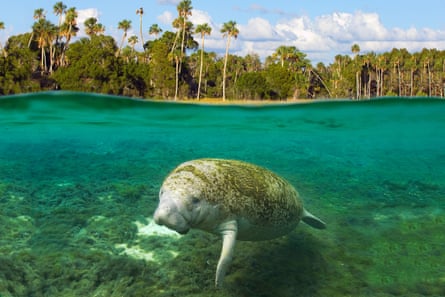
Top half of slip image is above the water, with palm trees on a shore, with the bottom half under water, with a manatee with green algae on its back.

A manatee in the Crystal River, in west-central Florida.
Photograph: All Canada Photos/Alamy

Additionally, more than 2 million out-of-state anglers visit Florida each year, renting charter boats and plowing plenty of dollars into hotels and restaurants.

“If you had to list what sets Florida apart and makes it such an iconic place for people to go and enjoy the outdoors, and the water and the fish and everything, our coast is our treasure,” Wiley said.

“But we hadn’t really looked at it as a connected corridor all the way around the coastline. It’s like the wildlife corridor’s sister on the coast that shows how you connect our estuaries all the way out through the grass flats into the deeper water.

“We already have a lot of partners from local government, non-profit, federal government, and state that are doing a lot of great work to protect our coastlines and provide habitat for fisheries, but it’s like here and there, scattered along the coastline.

“This pulls us all together under one great umbrella to inspire and provide a vision that we can all celebrate and leverage, and identify where we need to do better, make improvements, where we need to restore places and where we need to add habitat, from coral reefs all the way up to the grass flats.”

If you had to list what sets Florida apart and makes it such an iconic place … our coast is our treasure
Nick Wiley, Fish and Wildlife Foundation of Florida


FWC and FWFF leaders are partnering with local governments, scientists, reef builders, conservation organizations and coastal communities. One early project, planned for next month, is a collaboration with Collier county to lay a sizable new artificial reef about 13 miles from shore in the Gulf of Mexico.

Mike Norberg, a marine biologist with decades of experience in artificial reefs, who is also the coastal corridor’s project director, said a chain of prefabricated concrete structures 8ft-15ft would be lowered on to the seabed, and would mimic natural reefs to attract fish.

“There’s a number of benefits for artificial reefs,” he said. “It removes pressure from natural reefs, which obviously have a lot of ongoing challenges, especially in south Florida, and also creates habitats in areas where none might have existed.

“In parts of the coastal waters, it’s largely just sand sea floor and not a ton of natural reefs, especially when you look in the northern Gulf or north-eastern side of Florida. So it’s a win-win both for the ecosystem as well as recreational access opportunities, whether that’s fishing and diving or just going out and sightseeing and having fun.”

Norberg said strategic reef deployments were a priority for the first year, with other projects under way in Okaloosa county in the Panhandle, and Duvall county on the northern Atlantic coast.

Future plans, he said, include exploring coastal restoration projects to help address beach erosion, the loss of coastal mangroves that protect against storm surge during tropical events and the reduction in natural food stocks that sustain declining species, such as seagrass for manatees.

It’s a win-win both for the ecosystem as well as … just going out and sightseeing and having fun
Nick Wiley, Fish and Wildlife Foundation of Florida


“We’ve got a number of different projects that are in various stages of development in different parts of the state,” he said.

“We’re looking at various oyster bed restoration opportunities and how that can help tie in to this network of connected habitats, living shorelines. That’s a huge thing, one that helps improve coastal resiliency from a community perspective.

“It also provides habitat for juvenile fish and adult fish to spend their time within an estuary before they move offshore. So there really is this opportunity to tie both inshore to offshore habitats and use that as a tool for marine resource management.”

To Wiley, the creation of the coastal corridor represents what he says is a peak of his decades-long career in wildlife conservation in Florida.

“I see more excitement and opportunity on this one than anything I’ve touched,” he said. “It speaks to me so well in my heart about bringing people together to do great things for Florida’s environment and Florida’s coast, and I just see so much potential and opportunity for everybody to come in and be a part of it.

“As we’ve seen on the wildlife corridor, it will bring a deeper, richer identity to the state that will enrich and enhance the value of Florida for people that live here, and the people that want to come visit.”

 
Okaloosa County (September 15, 2026) – Destin-Fort Walton Beach’s Natural Resources Team and the Fish & Wildlife Foundation of Florida have begun deploying 1,500 tons, or three million pounds, of repurposed concrete culverts to create three new artificial reefs off the Destin-Fort Walton Beach coast.

The project is the second deployment as part of Florida’s Coastal Corridor, a statewide initiative led by the Fish & Wildlife Foundation of Florida and the Florida Fish and Wildlife Conservation Commission (FWC). The initiative’s first deployment took place off Naples on September 2.

“These collaborations are necessary to continue the statewide effort to improve habitat for marine life in the Gulf,” said Okaloosa County Board Chairman Trey Goodwin. “We appreciate the Fish & Wildlife Foundation of Florida for choosing Destin-Fort Walton Beach to add to our already vibrant artificial reef system.”

The reefs will be created roughly four to eight nautical miles from East Pass at a depth of about 68 to 74 feet. Each reef will include approximately 500 tons of concrete. The concrete culverts are being placed in concentrated configurations designed to create durable, complex hard-bottom habitat. Artificial reefs can provide areas for reef-associated fish and other marine life to feed, shelter, grow and reproduce while also expanding fishing and diving opportunities. This phase of the Coastal Corridor project is expected to be complete in November 2026.

“Thoughtfully planned artificial reefs can play an important role in conserving and enhancing marine habitat while supporting the long-term health of Florida’s fisheries,” said Roger Young, executive director of FWC. “Projects like this bring together sound science, careful site selection, durable materials and strong local partnerships to create habitat that supports marine life and helps sustain healthy marine resources for generations to come.”

Florida’s Coastal Corridor is designed to strengthen the interconnected habitats that support healthy fisheries and coastal ecosystems, from mangroves and seagrass beds to natural and artificial reefs. Through partnerships with FWC, local governments like Okaloosa County, scientists, conservation organizations and coastal communities, the initiative is building a coordinated network of habitat projects along Florida’s Gulf and Atlantic coasts.

“Three million pounds of reef material makes this a big deployment, but what excites us most is what it represents,” said Nick Wiley, executive director of the Fish & Wildlife Foundation of Florida. “We are beginning to turn the Coastal Corridor from a statewide vision into real habitat in Florida waters. Okaloosa County has been an outstanding partner, and this is exactly the kind of collaboration that will allow the initiative to grow from one community to the next.”

Contacts:

Okaloosa County: Nick Tomecek, ntomecek@myokaloosa.com

Fish & Wildlife Foundation of Florida: Michelle Ashton, mashton@wildlifeflorida.org
 
New posts


Sign Up for SoWal Newsletter


Back
Top